
Irregular income is the focus of this guide. A budget for income that changes every month has to give up one assumption standard budgets make: that you know what’s coming in before the month starts. One month lands $8,000 and the next $2,400 in my assumed example, and a budget built on a steady paycheck breaks the moment income swings. Here’s the approach I’d use.
Irregular income: Why Standard Budgeting Advice Fails Here
Most budgeting frameworks follow one sequence: know your income, allocate it, spend accordingly. With irregular income the first step is missing. In my view, that means the approach needs to adapt, not that budgeting is impossible.
Step One: Find Your Real Baseline
- List each month’s actual income for the past 6 to 12 months.
- Identify the lowest month in that window.
- Use that number, not your average, as a working baseline.
As an assumed example, if your income over the past year ranged from $3,000 to $9,000, budgeting off a $6,000 average leaves you short in every month below it. Budgeting off the $3,000 floor means your worst month is already covered, and anything above it is extra. That’s my suggestion, not a rule.
Step Two: Build a Zero-Based Budget on That Baseline
Once you have your floor number, assign each dollar a job before the month starts. In my approach, the list includes:
- Rent, utilities, groceries, insurance and minimum debt payments
- Taxes (see below)
- Retirement contributions
- Emergency fund contributions
- Specific savings goals, treated as line items
Step Three: Set Aside Taxes From Every Payment
The Rules
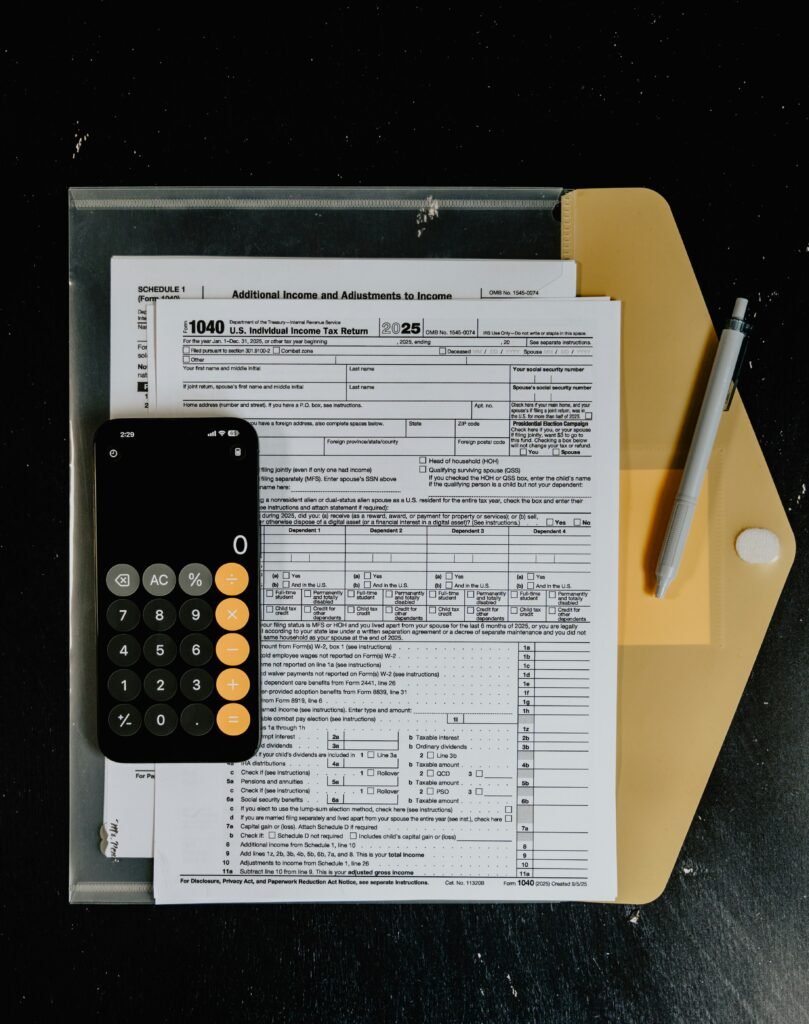
The IRS says self-employment tax is 12.4% for Social Security plus 2.9% for Medicare, applied to 92.35% of your net earnings from self-employment, that you usually owe it if you had net earnings of $400 or more, and that you can deduct one-half of it in figuring your adjusted gross income.
A Worked Example at $100,000 Net Profit
I calculated this with Python using the 2026 figures from IRS Rev. Proc. 2025-32 (the $16,100 single standard deduction and brackets of 10% to $12,400, 12% to $50,400 and 22% to $105,700). Assumptions: single filer, no other income, no credits, and a qualified business income deduction of 20% of taxable income before that deduction.
| Line (assumed single filer, $100,000 net profit) | Amount |
|---|---|
| Self-employment tax | $14,129.55 |
| Half of SE tax deducted | $7,064.77 |
| Taxable income after standard deduction and 20% QBI deduction | $61,468.18 |
| Federal income tax | $8,235.00 |
| Total federal | $22,364.55 (22.36%) |
State taxes aren’t included. Your own numbers will differ with filing status, deductions and state, so treat this as a method, not a rate. My suggestion: use a percentage of every payment that is a bit above what your own calculation or last year’s return shows, and keep it in a separate account.
Estimated Tax Payments
The IRS says you generally must make estimated payments if you expect to owe at least $1,000 after withholding and refundable credits. The payment dates it lists for income in 2026 are April 15, 2026, June 15, 2026, September 15, 2026 and January 15, 2027. If a date falls on a weekend or legal holiday, the next business day applies. It also lists safe harbors: 90% of this year’s tax, or 100% of last year’s (110% if your prior-year AGI was above $150,000).
Notice that the second period covers only two months (April and May). In my view, a separate account for this money makes it harder to spend by accident.
Step Four: Rebuild the Budget Every Month
I’d rebuild the budget monthly as income arrives:
- Start the month on your baseline.
- Add each payment as it comes in.
- If income beats the baseline, decide right away where the extra goes: savings, debt, taxes or a planned expense.
Planning for Strong Months and Slow Ones
In stronger months, my suggestions are to top off your emergency fund, set money aside for slow periods you know about, and avoid raising your baseline lifestyle on one good month.
In slower months, I’d draw from the buffer you built, limit spending to essentials for a while, and pause non-critical subscriptions.
How Big Should Your Buffer Be?
I don’t have an official figure to cite. My suggestion is to start with one month of essential expenses and build up from there, adding more if your income is especially uneven.
Retirement Savings Without an Employer Plan
Without an employer plan, retirement saving has to be set up on purpose. The IRS lists these 2026 limits:
- Traditional or Roth IRA: $7,500, plus a $1,100 catch-up at 50 or older.
- 401(k) employee deferral: $24,500 for 2026, which applies to a Solo 401(k) employee deferral. The IRS self-employed plans page says a Solo 401(k) can also take an additional employer contribution of up to 25% of net self-employment earnings, within an overall limit that adjusts every year.
- SEP-IRA: the IRS says contributions can’t exceed 25% of compensation, up to a dollar cap that adjusts annually. For the self-employed, compensation is net profit minus one-half of self-employment tax minus your SEP contribution.
The IRS says a SEP can be set up for a year as late as the due date (including extensions) of that year’s return, and that SEP contributions must be deposited by that date. Pre-tax contributions to a SEP or traditional account may lower your taxable income, while Roth contributions don’t.
Matching the Right Approach to Your Situation
- “My income varies a little.” → A baseline budget on your lowest recent month, rebuilt monthly.
- “My income swings with the season.” → Add a seasonal buffer funded in your busiest months.
- “I owe quarterly taxes.” → Set aside a share of each payment and mark the four due dates.
- “I have debt alongside irregular income.” → In my view, use surplus from strong months on high-interest debt.
- “I haven’t set up retirement savings.” → Compare the IRA, SEP and Solo 401(k) options above.
Common Questions About This
Should I budget on my average or my lowest month? My suggestion is your lowest recent month, so essentials are covered every month.
What percentage should I set aside for taxes? There’s no single figure. The worked example gave 22.36% federal for one set of assumptions, before any state tax.
Do I need to pay quarterly? Generally if you expect to owe at least $1,000 after withholding and refundable credits, per the IRS.
What do I do with extra income in a strong month? Decide immediately where it goes.
The One Habit That Makes This Work
Know your floor, give every dollar of it a job before the month starts (taxes included), and rebuild the budget monthly. In my view, that habit is what makes irregular income manageable.
This article offers general information and my own opinions, not financial, tax, or legal advice. The figures in worked examples are assumed. Laws, tax rules, and products change and can differ by location, so check current official sources and talk to a qualified professional about your own situation.
Sources:
- IRS: Topic no. 554, Self-employment tax
- IRS: Estimated tax
- IRS: 2026 retirement plan limits (IR-2025-111)
- IRS: Retirement plans for self-employed people
- IRS: Retirement plans FAQs regarding SEPs
Related reading: Freelance Hourly Rate: The After-Tax Formula That Actually Works and Give Every Dollar a Job: The Beginner’s Case for Zero-Based Budgeting.