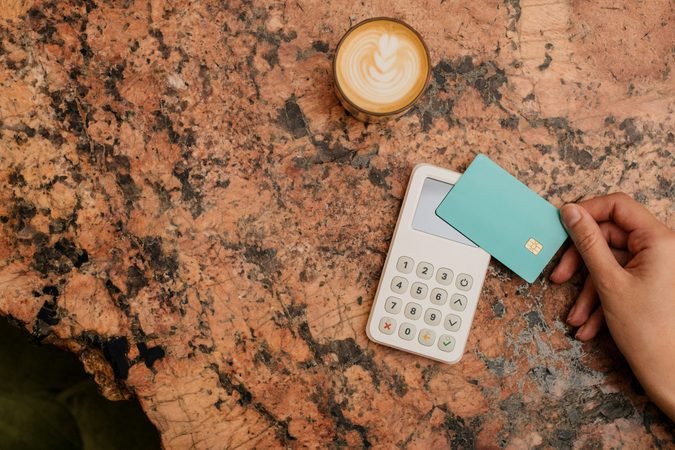
Crypto card is the focus of this guide. A $4 coffee paid for with a crypto debit card sounds trivial, but under the IRS’s published position, spending crypto can be a taxable event. The IRS says digital assets are treated as property (FAQ 48), and paying for goods or services with them is a disposition: you recognize a capital gain or loss, measured as the amount realized minus your adjusted basis (IRS digital asset FAQ 48, 62, 63). This article reports that rule, shows what it looks like in numbers, and gives practical ways to keep it simple.
Why a Swipe Can Count as a Sale
Because digital assets are property, using them to pay is treated as disposing of them in exchange for what you receive. The amount realized is the fair market value of what you received, reduced by certain transaction costs, and your gain or loss is that amount minus your adjusted basis.
An assumed example: Bitcoin bought for $60,000 is spent when it is worth $60,006. That is a $6 gain on that unit, small enough to be easy to overlook. The numbers are made up for illustration.

A Coffee Every Day (Assumed Numbers)
Here is how small amounts can add up in your records. Assume a $4.00 coffee each day, paid with coins whose basis was $3.80. Each purchase is a $4.00 amount realized minus $3.80 basis, a $0.20 gain. Over 365 days that is 365 separate transactions and $73.00 of total gain. If the coins had instead been bought at a higher price and fell, each purchase would be a loss, for example $4.00 − $4.30 = −$0.30. The point is the number of entries, not the dollars.
| Assumed daily coffee | Per purchase | Over 365 days |
|---|---|---|
| Gain (basis $3.80) | +$0.20 | +$73.00 |
| Loss (basis $4.30) | −$0.30 | −$109.50 |
Reporting
The IRS says capital transactions are reported on Form 8949 (unless your broker provided a Form 1099-DA with proceeds and basis) and summarized on Schedule D (IRS FAQ 109). Short-term versus long-term treatment depends on whether you held the asset for one year or less, or longer (IRS FAQ 50). The IRS also says that whether or not you receive a Form 1099-DA, you must report all income, gains and losses from digital asset transactions, and that taxpayers using foreign exchanges may not get one (IRS: Understanding your Form 1099-DA).
Choosing Which Units You Spend
The IRS FAQ says that for units held in a single unhosted wallet you may identify the basis and holding period of the units you sell or dispose of, no later than the transaction, and must keep adequate records (FAQ 82). If you don’t meet that, a default rule treats units as disposed of in order of acquisition, earliest first (IRS FAQs on digital asset transactions).
What’s Been Proposed
A Tax Adviser article dated August 31, 2026 describes two proposals. The Lummis bill (S. 2207), introduced in June 2025, would add a $300 de minimis exclusion per digital asset transaction, with an inflation-adjusted annual total cap of $5,000, and the exclusion would not apply to sales involving cash or cash equivalents, business property or income-producing property. The PARITY Act (H.R. 8899), introduced in May 2026, includes no general de minimis exclusion but would provide that no gain or loss is recognized on the sale of a regulated payment stablecoin unless the taxpayer’s basis is less than 99% of its redemption value (The Tax Adviser). The article describes both as proposals and reports no enactment.
In my view, until a bill is signed, the safer approach is to keep records under today’s rules. That’s my suggestion, not tax advice.
If the Crypto Has Fallen in Value
By the same rule, if the crypto you spend is worth less than your basis, the result is a capital loss. The IRS says losses on digital assets are subject to limitations on the deductibility of capital losses and refers to Publication 544 for them (IRS FAQ 49). IRS Topic 409 says that if capital losses exceed capital gains, you can deduct the lesser of $3,000 ($1,500 if married filing separately) or your net loss, with any excess carried forward (IRS Topic 409). Whether a particular loss is deductible depends on your situation.
A Practical Way to Handle This
- Keep records of each purchase’s date, basis and value when spent. That’s my suggestion, since the IRS formula above needs both numbers.
- Consider tracking software if you use a card regularly. In my view, doing this by hand becomes tedious quickly.
- Track losses as carefully as gains. Losses are reportable the same way.
- Decide how you’ll identify units before you start, since the IRS FAQ says identification is made no later than the transaction.
- Treat pending legislation as pending. Plan under current rules.
Questions About Crypto Card Purchases and Tax
Does this apply to every crypto? The IRS FAQ says digital assets are treated as property, which covers the digital assets it discusses.
Would a new exemption apply to past purchases? I don’t know. Effective dates depend on the final text of any law.
My Take on Every Crypto Card Purchase Is Taxable
- Everything above is the current IRS position and pending proposals. This part is mine.
- In my view, knowing that a purchase can be a reportable event before you start using a card makes record-keeping easier, since you can capture the numbers as you go instead of reconstructing them later.
- In my suggestion, a quick monthly export from your card or wallet, saved in one folder, turns a year of small purchases into a manageable task.
Sources
- IRS: Frequently asked questions on digital asset transactions
- IRS: Understanding your Form 1099-DA
- IRS: Topic 409, Capital gains and losses
- The Tax Adviser: Tax legislation for digital assets (Aug 2026)
This article offers general information and my own opinions, not financial, tax, or legal advice. The figures in worked examples are assumed. Laws, tax rules, and products change and can differ by location, so check current official sources and talk to a qualified professional about your own situation.
Related reading: The Wash Sale Loophole Crypto Investors Should Know and The $15,000 Question Nobody Asks in a Crypto Divorce: Which Lot Are You Actually Transferring?.